Previous: Factor 6 - Competitor Defensive Positioning
This article forms one part of a broader decision framework for evaluating whether patent or trade secret protection is appropriate for AI innovation.
The framework is designed to help decision-makers (e.g., innovaters, in house, CTOs) align patent and IP strategy with underlying business realities and moving beyond purely "legal" considerations.
Patentable potential addresses whether the innovation is likely to satisfy the main requirements for patentability: novelty, non-obviousness and subject-matter requirements.
This assessment is highly fact-specific and depends on the prior art landscape and how the invention is framed. Early analysis helps determine whether patent protection is realistic and worth pursuing. For a more in-depth discussion on the topic, we encourage you to review our prior publication Artificial Intelligence Patenting: Top Challenges and Key Considerations.
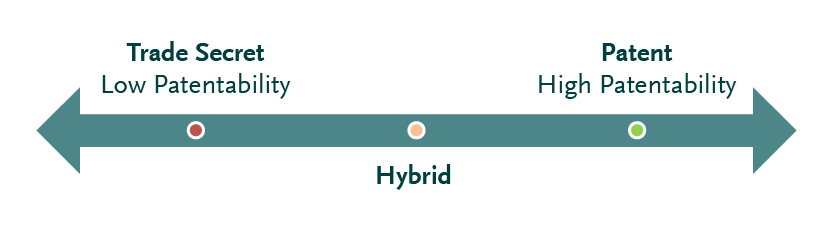
In a multi-layer analysis, you may choose to proceed with a patent application even if patentability is low, if other factors are in favor of patenting. For example, if there is a desire to position an application for defensive blocking, that may be reason to proceed even if patentability is in question.
Beyond Patents vs. Trade Secrets: A Layered Strategy
Patent protection decisions are rarely binary. Effective AI portfolios often rely on a layered strategy that aligns different forms of protection with different aspects of the technology.
- Patents are typically best suited for externally visible applications, system behavior and technical effects that can be observed, reverse-engineered or independently developed by competitors.
- Trade secrets are more appropriate for elements that derive value from remaining hidden, such as training data, data engineering workflows, model tuning strategies and internal performance optimizations.
- Contractual controls and internal policies then operate as a supporting layer, reinforcing confidentiality obligations, limiting misuse in partnerships or joint ventures and helping preserve trade secret status over time. As noted in our previous publications, AI companies are strongly advised to deploy internal Trade Secret, Confidentiality and IP Policies as added safeguards (see X.AI Corp. v. OpenAI—Why Every Business (and Start-Up) Needs an Employee Governance Policy for Managing Confidential Business Information and IP Risk).
Applying the Decision Tool: Patents or Trade Secrets
For a further discussion of the decision framework and remaining decision factors in the framework, please see the following:
Framework: Patents or Trade Secrets
Factor 1: Nature of AI Innovation
Factor 2: Enforceable Scope of Patent Protection
Factor 3: Reproducibility of AI Innovation
Factor 4: Business Delivery Model
Factor 5: Commercial Longevity
Factor 6: Competitor Defensive Positioning
If your organization needs assistance evaluating which aspects of its AI innovation are better suited to patent protection versus trade secret protection, our team can help. Our team can also support patent filing and the development of a broader IP strategy.