Next: Factor 6 - Competitor Defensive Positioning
Previous: Factor 4 - Business Delivery Model
This article forms one part of a broader decision framework for evaluating whether patent or trade secret protection is appropriate for AI innovation.
The framework is designed to help decision-makers (e.g., innovators, in house, CTOs) align patent and IP strategy with underlying business realities and moving beyond purely "legal" considerations.
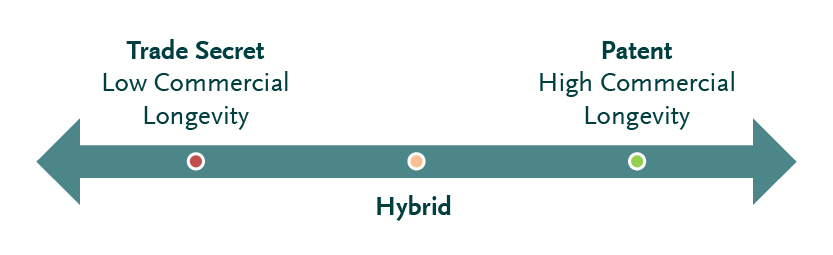
Commercial longevity considers whether the AI innovation is likely to remain commercially relevant long enough to justify patent protection.
Innovations with short life cycles may not justify the time and cost of patenting, whereas durable capabilities that persist across product generations and address stable problem domains are stronger candidates. It is important to note that a patent can take several years to grant, and enforceable rights arise only after issuance.
|
Examples: Commercial Longevity
- Patents (High Commercial Longevity): Medical AI Imaging Analysis
An AI-based medical image analysis system for detecting common pathologies in diagnostic imaging, where the clinical need, imaging modalities and core input features evolve slowly over time. As a result, the underlying model logic and outputs remain relevant across multiple product generations, allowing the innovation to retain long-term commercial value.
In this example, product iterations/evolutions are not necessarily based on revising the big picture AI innovation (e.g., using AI to detect medical pathologies), but on the small picture AI innovation (e.g., tweaking the implementation for greater accuracy).
- Trade Secrets (Low Commercial Longevity): AI-Enabled Inspection Module
An AI-enabled inspection module designed to be deployed with handheld or mounted scanning hardware to support a one-time infrastructure upgrade program, such as the rollout of a new generation of smart utility meters.
During the upgrade period, the AI analyzes sensor readings and device identifiers to verify installation correctness and compatibility with legacy systems. The module is sold or licensed to utilities and contractors specifically for the duration of the rollout.
Once the upgrade program is completed and legacy meters are retired, the need for the module largely disappears, giving it limited commercial longevity. This case may therefore favor trade secret protection.
- Hybrid Approach (Patents/Trade Secrets): Smart Fashion AI Platform
A smart fashion platform may use AI to analyze images captured by a wearable camera or smartphone to identify clothing items and basic visual attributes (e.g., color, fit and layering). This core capability addresses a persistent and reusable problem across many fashion applications and does not depend on short-term trends, making it well suited to patent protection.
A second, interrelated component may support a specific brand collaboration or limited-run campaign. In this case, the AI is re-adapted or retrained to recognize collection-specific garments or styling rules that apply only to that collaboration. Because this behavior is tied to a time-limited commercial initiative and may not be reused, its commercial longevity is uncertain, making it better suited to trade secret protection.
|
Applying the Decision Tool: Patents or Trade Secrets
For a further discussion of the decision framework and remaining decision factors in the framework, please see the following:
Framework: Patents or Trade Secrets
Factor 1: Nature of AI Innovation
Factor 2: Enforceable Scope of Patent Protection
Factor 3: Reproducibility of AI Innovation
Factor 4: Business Delivery Model
Factor 6: Competitor Defensive Positioning
Factor 7: Patentability Potential and Layered Strategies
If your organization needs assistance evaluating which aspects of its AI innovation are better suited to patent protection versus trade secret protection, our team can help. Our team can also support patent filing and the development of a broader IP strategy.