Next: Factor 2 - Enforceable Scope of Patent Protection
Previous: Decision Framework
This article forms one part of a broader decision framework for evaluating whether patent or trade secret protection is appropriate for AI innovation.
The framework is designed to help decision-makers (e.g., innovators, in house, CTOs) align patent and IP strategy with underlying business realities and moving beyond purely "legal" considerations.
Within that framework, this article addresses a first decision factor: what exactly is the AI innovation, or more specifically, what incremental advance over existing technology is proposed?
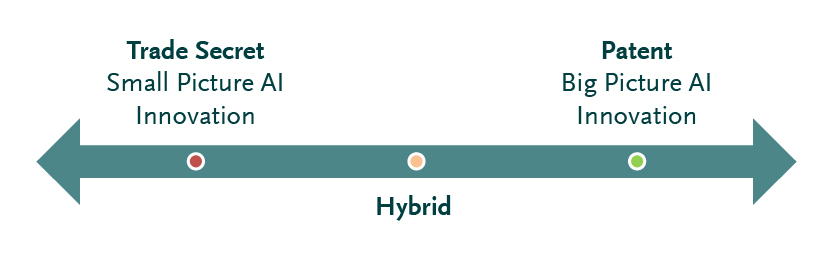
Innovation in applied AI often sits somewhere along the spectrum between the big picture level (or application-level innovation) and the small picture level (or implementation-level innovation). As discussed below, this distinction informs much of the remaining framework.
Patents: Big Picture AI Innovation
Big picture AI innovation encompasses new applications or system-level approaches for using AI. This type of innovation is often better suited to patent protection because it represents more visible, high-level advances. Such innovations are easier for competitors to observe and replicate, which increases the value of securing patent rights.
|
Example: Crop Stress AI Detection In an agricultural application, an innovation is developed to analyze images of crops to identify crop stress using broad AI-based image analysis techniques. The innovation here lies at the application level, in recognizing crop stress detection as a suitable application for image-based AI analysis. The innovation may also involve identifying which image features are most informative for training an accurate crop stress model, as well as the nature of the resulting model outputs. The novelty of the innovation therefore is not the specific type of AI architecture used (i.e., other than image analysis AI models, broadly), but its general application. |
Trade Secrets: Small Picture AI Innovation
Small-picture AI innovation involves improving performance or efficiency through implementation-level refinements within an AI system. It often lies in model tuning or architectural details that are difficult to detect externally and are therefore better protected as trade secrets. In some cases, small picture AI may still warrant patent protection where other factors counterbalance the narrow technical scope (e.g., commercial value, etc.)
|
Example: Geological AI Image Analysis The use of computer vision (broadly) to identify mineralization patterns in geological imagery is well known (i.e., in this hypothetical case). However, improved accuracy can be achieved by deploying a specific and more complex computer vision model architecture tailored to the visual characteristics of core samples or rock surfaces. The innovation here lies at the implementation level of the AI itself. It is localized within the model architecture and focused on system optimization. It is not focused on the big-picture application of image-based geologic mineral analysis. As noted above, patent protection may still be appropriate in these cases where other factors, such as commercial relevance, outweigh the narrow technical scope. |
Hybrid Approach (Patents/Trade Secrets)
Technological innovation will most often lie somewhere between the two extremes. In many cases, in fact, AI innovation may include elements of both big picture and small picture innovation. This can require a hybrid patent/trade secret approach.
|
Example: AI-Driven Analysis of Oilfield Imagery A novel application is proposed for AI-based image analysis to identify subsurface features or anomalies in oilfield downhole well imaging data (e.g., downhole camera images). Therefore, patent protection may be pursued over the application-level concept. Further, to satisfy patent disclosure and novelty requirements, the patent can describe the overall system flow, data inputs, expected outputs and relevant feature categories. At the same time, specific implementation details used to optimize performance of the image analysis (e.g., proprietary model architectures, tuning parameters, feature weighting strategies and training heuristics), can be retained as trade secrets. These details are not required for enablement of the patented invention or to establish novelty and can be kept confidential to preserve a competitive advantage beyond the patent term. |
Applying the Decision Tool: Patents or Trade Secrets
For a further discussion of the decision framework and remaining decision factors in the framework, please see the following:
Framework: Patents or Trade Secrets
Factor 2: Enforceable Scope of Patent Protection
Factor 3: Reproducibility of AI Innovation
Factor 4: Business Delivery Model
Factor 5: Commercial Longevity
Factor 6: Competitor Defensive Positioning
Factor 7: Patentability Potential and Layered Strategies
If your organization needs assistance evaluating which aspects of its AI innovation are better suited to patent protection versus trade secret protection, our team can help. Our team can also support patent filing and the development of a broader IP strategy.