As artificial intelligence innovation accelerates, inventors, chief technology officers (CTOs) and in-house teams are increasingly confronted with a fundamental protection question: does it make sense to file a patent, or is the better strategy to rely on trade secret protection?
While the patent lawyer may be biased towards "always patent", companies need to address more substantive business realities, including the true value add of a patent versus its cost.
Why a Decision Framework?
The question of patenting AI (or keeping it a trade secret and confidential) is, in many ways, not fundamentally different from the longstanding challenges surrounding software patenting, since AI innovation is primarily software-driven.
At the same time, AI introduces distinct considerations from other classes of software innovation. Most notably, the effectiveness of an AI platform often turns on the quality of its training data. That means that even if a patent discloses all the details of an applied AI or machine-learning model, that disclosure can, in certain cases, be of subdued consequence, especially if competitors lack access to that same quantitative and qualitative data repository.
As with many complex decisions, whether to pursue patent or trade secret protection for AI innovation is best approached through the lens of a practical, objective framework. That framework should focus on aligning patent and IP strategy with underlying business realities and moving beyond purely "legal" considerations.
From a governance perspective, such frameworks also enable decisions that are "defensible" and "explainable", both to internal stakeholders (e.g., executives and management) and external stakeholders (e.g., investors and shareholders).
Decision Tool: A 7-Point Framework
It's suggested that decision-makers weigh seven factors in determining whether patent or trade secret protection is the more viable approach for protecting AI innovation.
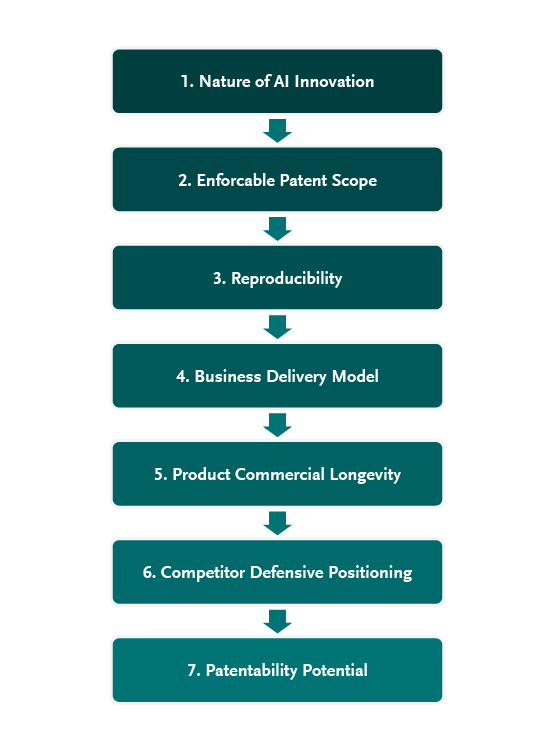
Taking a step back, AI innovation is broadly categorized into "core AI" and "applied AI".
Core AI refers to advances in the underlying engines themselves, such as new mathematical model architectures, learning paradigms or training methods. Applied AI, by contrast, involves adapting existing AI engines and models to solve specific, real-world problems, often through domain-specific training data and deployment choices (see for example AI in Oil and Gas).
For ease of discussion, this framework focuses only on applied AI, as it represents the most common and commercially relevant form of AI innovation in practice.
Please note as well that, while the proposed framework is relevant to patenting generally, it has been tailored to address the specific and unique aspects of AI technologies, and their development and deployment. The framework may also share overlap with broader software patenting considerations.
Applying the Decision Tool
In the following seven installments, we examine each of the seven decision points, providing actionable insights and examples to help technology leaders make informed, business-aligned IP choices.
Factor 1: Nature of AI Innovation
Factor 2: Enforceable Scope of Patent Protection
Factor 3: Reproducibility of AI Innovation
Factor 4: Business Delivery Model
Factor 5: Commercial Longevity
Factor 6: Competitor Defensive Positioning
Factor 7: Patentability Potential and Layered Strategies
For a further discussion on layered IP strategies for AI innovation, please also see our on-demand video Intellectual Property: Key Considerations at Every Stage of the AI Value Chain.
If your organization needs assistance evaluating which aspects of its AI innovation are better suited to patent protection versus trade secret protection, our team can help. Our team can also support patent filing and the development of a broader IP strategy.
 Bennett Jones