Next: Factor 4 - Business Delivery Model
Previous: Factor 2 - Enforceable Scope of Patent Protection
This article forms one part of a broader decision framework for evaluating whether patent or trade secret protection is appropriate for AI innovation.
The framework is designed to help decision-makers (e.g., innovators, in house, CTOs) align patent and IP strategy with underlying business realities and moving beyond purely "legal" considerations.
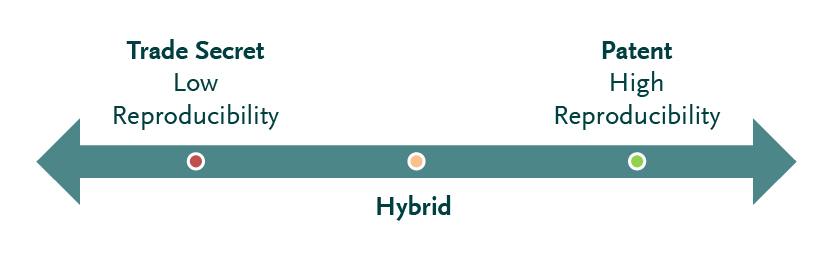
Reproducibility considers whether a competitor could realistically replicate the AI innovation by reviewing your public materials or otherwise by obtaining limited access to the system itself.
If the core functionality can be inferred or reverse-engineered from these sources, trade secrets are of little value since the innovation is readily discoverable. In these cases, patent protection may be more useful to prevent straightforward copying.
To that end, reproducibility is often driven by the deployment environment in which an AI innovation operates. Cloud-based systems, local installations and edge deployments present different levels of visibility, which in turn affect how easily a competitor can access or study the system.
The factors indicating reproducibility are closely aligned with those discussed in the previous factor under “detectability of infringement,” as they represent two sides of the same coin.
|
Examples: Reproducibility
- Patents (High Reproducibility): Local or Edge-Deployed, User-Facing Product
An AI feature embedded in an edge-deployed consumer product that performs real-time image or signal analysis and produces observable, repeatable outputs. Because the functionality runs locally and its behavior can be tested by varying inputs and measuring outputs, competitors can broadly infer the overall processing logic, making the capability easy to reproduce.
- Trade Secrets (Low Reproducibility): Cloud-Deployed, Bundled Product
An AI capability implemented as a subcomponent of a bundled, cloud-based platform where the functionality is distributed across multiple backend services, data pipelines and orchestration layers. Inputs may be abstracted, outputs may be aggregated or post-processed and internal workflows are hidden from users.
The lack of visibility into the integrated platform architecture makes the capability difficult to decipher or replicate, favoring trade secret protection.
- Hybrid Approach (Patents/Trade Secrets): Multi-Component AI Product
An AI capability deployed as a module within a larger software platform that provides defined inputs and outputs with consistent, testable behavior, while relying on backend processing that is not fully visible.
Core functional logic and system-level interactions are observable and can be disclosed and protected through patents (big picture AI). In contrast, certain internal data transformations and optimization routines (small picture AI) are not directly visible and remain difficult to reverse engineer.
This intermediate level of reproducibility supports a hybrid approach, combining patent protection for the externally discernible aspects with trade secret protection for internal implementation details.
|
Applying the Decision Tool: Patents or Trade Secrets
For a further discussion of the decision framework and remaining decision factors in the framework, please see the following:
Framework: Patents or Trade Secrets
Factor 1: Nature of AI Innovation
Factor 2: Enforceable Scope of Patent Protection
Factor 4: Business Delivery Model
Factor 5: Commercial Longevity
Factor 6: Competitor Defensive Positioning
Factor 7: Patentability Potential and Layered Strategies
If your organization needs assistance evaluating which aspects of its AI innovation are better suited to patent protection versus trade secret protection, our team can help. Our team can also support patent filing and the development of a broader IP strategy.
 Bennett Jones