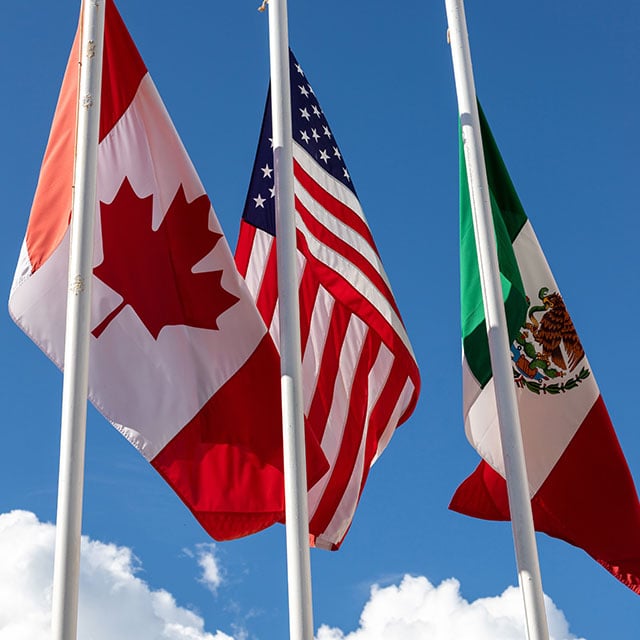
The global trade environment affecting the life sciences sector is undergoing a marked transformation. Escalating tariff measures, heightened national security scrutiny and renewed industrial policy ambitions are converging to alter how governments regulate, support and constrain cross‑border trade activity in this sector.
Key Takeaways
The following global trade issues will affect the life sciences sector in 2026 and beyond:
- US Tariffs and other measures: The United States is using Section 232 tariffs to pressure pharmaceutical and medical device manufacturers to shift production and R&D to the United States.
- Canada’s response remains fluid, but risks are rising. While many retaliatory tariffs have been rolled back, further countermeasures remain possible. Companies should prepare for increased customs, supply‑chain and pricing scrutiny, as well as potential provincial‑level procurement restrictions.
- CUSMA renewal poses material uncertainty for life sciences trade. The 2026 Canada-United States-Mexico Agreement (CUSMA) review will revisit key pharmaceutical issues—including pricing, IP, data protection and market access—placing significant North American trade flows at risk if renewal is not secured.
- Regulatory alignment within Canada is improving, with limits. The new Mutual Recognition Agreement should ease interprovincial trade but carve‑outs for pharmaceuticals and medical devices may blunt its effect for some life sciences businesses.
- Security, export controls and sanctions are reshaping market access. Governments are increasingly treating life sciences products as strategic assets, expanding export controls and sanctions regimes and heightening compliance obligations across global supply chains.
US Tariffs and Other Regulatory Measures
In 2025, the US Department of Commerce’s Bureau of Industry and Security initiated two separate investigations under Section 232 of the Trade Expansion Act of 1962 to assess the national security implications of imports of (1) Pharmaceuticals and pharmaceutical ingredients, including finished drug products, medical countermeasures, critical inputs such as active pharmaceutical ingredients and key starting materials, and derivative products of those items (collectively, pharmaceuticals); and (2) Personal protective equipment, medical consumables and medical equipment, including devices (collectively, medical devices).
Both these processes remain ongoing, but may result in significant, targeted tariffs. Although the Department of Commerce has yet to publish its reports in these proceedings, the administration announced that, starting October 1, 2025, it would impose 100% tariffs on branded and patented pharmaceuticals unless companies are actively building production facilities in the United States. Although implementation has been temporarily paused amid ongoing discussions with major pharmaceutical companies, the threat alone has already prompted announcements of substantial investment in US facilities.
On April 2, 2026, the administration issued a proclamation disclosing the results of the Department of Commerce Section 232 investigations, namely that present quantities and circumstances of imports of patented pharmaceuticals threaten to impair the national security and economy. Through the proclamation, the administration has directed that (i) agreements be negotiated with countries exporting pharmaceuticals to the United States; (ii) a 100% ad valorem tariff be imposed on imports of pharmaceuticals listed in the proclamation (absent the application of a preferential rate) to take effect in respect of goods entered for consumption or withdrawn from warehouse for consumption on or after July 31, 2026; (iii) a 20% ad valorem tariff be imposed on imports of pharmaceuticals produced by companies that have US government approved plans to onshore production of the pharmaceuticals, which tariff will increase to 100% after four years of the date of the proclamation; (iv) no tariffs will be imposed on imports of pharmaceuticals produced by companies that have fully executed agreements or are negotiating agreements with the US administration regarding MFN (Most Favoured Nation) pricing and the onshoring of pharmaceutical production and R&D. No measures are currently being imposed on generic pharmaceuticals.
The US administration has already negotiated trade agreements with several major pharmaceutical exporting countries and regions, such as Switzerland, South Korea, Japan and the European Union, which each signed on to agreements with specific protections for pharmaceutical exports to the United States capping any tariff measures at 15%. The April 2 proclamation declares that pharmaceutical-related commitments in these existing trade deals, including the trade agreement with Switzerland, among other countries and regions, must be implemented.
These actions reflect a significant and structural shift in how pharmaceutical trade is being handled in Washington. Historically, the pharmaceutical sector has been less exposed to disruption from trade measures than other sectors. Even during the COVID 19 pandemic—when severe shortages underscored the fragility of global supply chains—the US response focused on emergency procurement and temporary controls, not on imposing lasting trade barriers.
The policy objective behind the Section 232 proceedings appears to be the redomiciliation of pharmaceutical production and R&D to the United States. In a stick and carrot approach, tariffs threatened and imposed through the Section 232 proceedings have been complemented by domestic measures aimed at reducing regulatory barriers to domestic pharmaceutical production and prescription drug costs.
Canadian Counter-Tariffs and Relief Structures
Although the government of Canada initially imposed retaliatory tariffs on a wide range of goods in response to US tariff measures, most of these tariffs were removed as of September 1, 2025. However, importers of subject goods imported during the period in which the tariff measures were in force who failed to declare them as such or pay the tariffs are still vulnerable to retroactive assessments and penalties. Importantly, Canada's tariff framework targeting US-origin goods provides for the remission of tariffs on goods imported by organizations that produce or store medical countermeasures (e.g., pharmaceuticals and medical devices) for healthcare purposes.
It is not clear how Canada will respond to the imposition of Section 232 tariffs on patented pharmaceuticals. To date, Canada has adopted a tit-for-tat approach in responding to US tariff measures. However, in light of public health sensitivities post-pandemic and Canada’s significant reliance on foreign produced medicines, Canada's approach may be more concessionary. Moreover, a substantial portion of Canadian pharmaceutical exports to the United States are generic pharmaceuticals, not patented pharmaceuticals, and therefore for the time being will not be exposed to the tariffs. Nonetheless Canada has launched a task force to prepare and issue a report prior to the formal launch of the CUSMA review with options for Canada's response.
If retaliatory measures are ultimately imposed, companies should be prepared for heightened customs compliance obligations involving tariff classification, country of origin analysis and valuation. They may also need to evaluate whether restructuring of supply chains, pricing methodologies, or manufacturing footprints is required to mitigate exposure.
Retaliatory responses at the provincial level, particularly in provincial procurement laws and policies, are also shaping market access and supply‑chain strategy for life sciences companies in Canada. In Ontario, for example, the government implemented a Procurement Restriction Policy that generally prohibits public‑sector entities (including hospitals, universities, colleges and other broader public‑sector organizations) from procuring goods and services from “US businesses,” subject to limited exceptions. The policy applies broadly to new procurements of any value and is not limited to pharmaceuticals or medical devices, but its practical impact is acute in the life sciences sector, where public‑sector purchasers play a central role in healthcare delivery and procurement. Notably, the definition of a “US business” turns on the location of a supplier’s headquarters or controlling entity and the size of its Canadian workforce, rather than formal place of incorporation, capturing some Canadian‑operating entities that may not view themselves as US suppliers.
CUSMA Review
Canada, the United States and Mexico are preparing for the mandatory review of the CUSMA scheduled for July 1, 2026. All three countries held public consultations on issues to be considered during the joint review. The following issues, relevant for the life sciences sector, have been identified as potential candidates for discussion:
- Ensuring stable market access for pharmaceutical products and ingredients
- Addressing concerns related to reference pricing for pharmaceuticals (e.g. Canada's Patented Medicines Prices Review Board pricing guidelines)
- Revisiting concerns related to biologics data protection, including the periods of protection for biologics in Canada and Mexico
- Reviewing patent related provisions of the CUSMA, including the scope of patentable subject matter, as well as patent enforcement practices.
If the three countries unanimously agree to renew CUSMA following the 2026 review, the agreement will be extended for an additional 16-year period. If consensus is not reached, the parties will be required to meet annually until the CUSMA expires in 2036 or until agreement is reached to renew the CUSMA. Any party may also exercise its right to withdraw from the CUSMA, at any time, on six months notice to the other parties.
Hanging in the balance of CUSMA's renewal is pharmaceuticals trade in the North American market, valued in 2024 by some sources in excess of US$600 billion.
Interprovincial Trade
On November 19, 2025, the Canadian Mutual Recognition Agreement (CMRA) was signed by the federal government and all provinces and territories in an effort to significantly reduce inter-provincial trade barriers. The CMRA is expected to take full effect by June 2026.
The CMRA establishes a national mutual‑recognition framework under which a good that may be lawfully sold in one province or territory may generally be sold across Canada without having to meet additional or duplicative regulatory requirements.
The CMRA is expected to improve production efficiency, enable economies of scale and facilitate expansion—especially for small and medium‑sized enterprises that lack the resources to navigate multiple regulatory regimes. At the same time, the CMRA preserves regulatory autonomy by allowing governments to maintain measures that pursue legitimate public policy objectives, such as health, safety, environmental protection or language requirements, provided those measures are expressly identified as exceptions.
The utility of the CMRA in facilitating greater intra-Canadian trade may be limited for some segments of the life sciences sector in light of exceptions taken by some provinces in respect of regulations applicable to pharmaceuticals and medical devices, as well as pesticides. Additionally, the CMRA does not address labour mobility issues in the health services sector. The International Monetary Fund recently estimated that policy-related barriers within Canada in the educational and healthcare service sectors exceed the equivalent of a 40% tariff.
Defence and National Security Considerations
Following commitments made in the 2019 federal budget, Public Safety Canada published the Sensitive Technology List (STL) in 2023. The STL identifies eleven broad technology areas that the Government of Canada has deemed to present significant national security implications, including life science technology. Life science technology encompasses a wide array of technologies that enhance living organisms, such as biotechnology and medical and healthcare technologies, some of which have dual uses.
The STL is intended to serve as a strategic policy tool to guide federal initiatives and to support the protection of Canadian innovation and the development of sensitive technologies. Although it is not formally incorporated into any statutory or regulatory instrument, the government has indicated that it will be used to inform a range of policy decisions, including foreign investment reviews and export control measures, as well as related national security-driven assessments across government.
Recognizing biodefence and medical countermeasure readiness as key economic and national security priorities among western countries, the Government of Canada has also taken steps to secure supply chains for critical inputs and goods in this area. In 2025, the federal government announced the creation of Health Emergency Readiness Canada, which is intended to support the development and production of medical countermeasures in the event of a health emergency, as well as a budgeted C$1 billion for a new Venture and Growth Capital Catalyst Initiative, which is intended to prioritize investment in "important sectors such as the life sciences sector" through a new Life Sciences Fund.
In February 2026, the federal government released its new defence industrial strategy, announcing additional measures in support of the development and production of medical countermeasures and biodefence, including prioritization of funding under the Strategic Response Fund and Life Sciences Fund to support the life science sector's participation in the defence industrial strategy. This is intended to include large‑scale transformation projects to enable the production of critical defence inputs and to expand biodefence and medical countermeasures capacity, as well as production, processing, stockpiling and procurement of defence-critical minerals.
Export Controls and Sanctions
More broadly, the expanding use of export controls and related national security tools by Canada and its allies signals a shift away from a purely commercial conception of life sciences trade. Controls that were once narrowly targeted at defence technologies are increasingly being applied to inputs and products viewed as critical to public health resilience, biodefence and emergency response. For life sciences companies, this evolution raises both compliance and strategic considerations: licensing timelines may affect the viability of time‑sensitive shipments; changes in destination risk profiles may alter market access assumptions; and enhanced scrutiny of end‑users and supply chains may require more robust internal controls.
For example, the export of certain life sciences‑related goods (e.g., medical isotopes and other radioactive materials used in diagnostics and treatment) is regulated by the Canadian Nuclear Safety Commission (CNSC) under the Nuclear Safety and Control Act. Even where exports are intended solely for medical or humanitarian use, exporters may be required to obtain CNSC licences and satisfy end‑use, destination and compliance conditions grounded in Canada’s international non‑proliferation commitments. These requirements operate alongside, and independently from, Global Affairs Canada’s export control regime, underscoring the need for careful jurisdiction‑specific analysis when structuring cross‑border movements of sensitive medical products.
Increased use of economic sanctions as a foreign policy tool to restrict trade in and with persons in certain countries and regions also underscores the importance to robust due diligence by life sciences companies in respect of their transactional and supply chain partners. The Restricted Goods and Technologies List, introduced by the Government of Canada in 2023 and incorporated by reference into specific regulations enacted under the Special Economic Measures Act, Canada's main autonomous sanctions legislation, restricts the export of items such as vaccines, certain pharmaceuticals and protective, detection and testing equipment for use in medical and pharmaceutical applications.
As governments continue to align trade policy with security and industrial objectives, export controls are likely to play a more prominent role in shaping how life sciences companies design, document, and defend their global distribution models.
If you have further questions about this update or life sciences issues more generally, please contact the authors or a member of the Life Sciences group.